Netflix filed its quarterly report for the three months to 30 September on 21 October. Revenue was $12.87bn, 11.8 per cent more than a year earlier. Operating income was $4.46bn, up from $3.25bn, and the operating margin rose from 28.2 per cent to 34.6 per cent. Diluted earnings per share rose from $0.59 to $0.87.
Two things sit underneath those figures. The first is that both years carry an item that will not recur. The second is that a streaming service does not expense content when it pays for it. It capitalises the spending and charges it to earnings over the years the titles are watched. This quarter the gap between what Netflix paid and what it charged was the widest in the period examined here.
Both Years Carry a One-Off
Cost of revenues in the third quarter of 2025 included a $619m expense for non-income tax assessments in Brazil, which the filing identifies as the main reason cost of revenues fell in the quarter. Excluding that charge, the margin a year earlier would have been 33.6 per cent rather than 28.2 per cent, and operating income would have risen by 15.3 per cent rather than 37.3 per cent.
The current year has its own item. In February Warner Bros. Discovery ended its merger agreement with Netflix to accept an offer from Paramount Skydance, which paid Netflix a $2.8bn termination fee on its behalf. The fee is in interest and other income for the first quarter. Before tax it equals almost three quarters of the $3.79bn rise in nine-month net income, from $8.56bn to $12.35bn.
Nine Months to September, Reported and Excluding the Fee
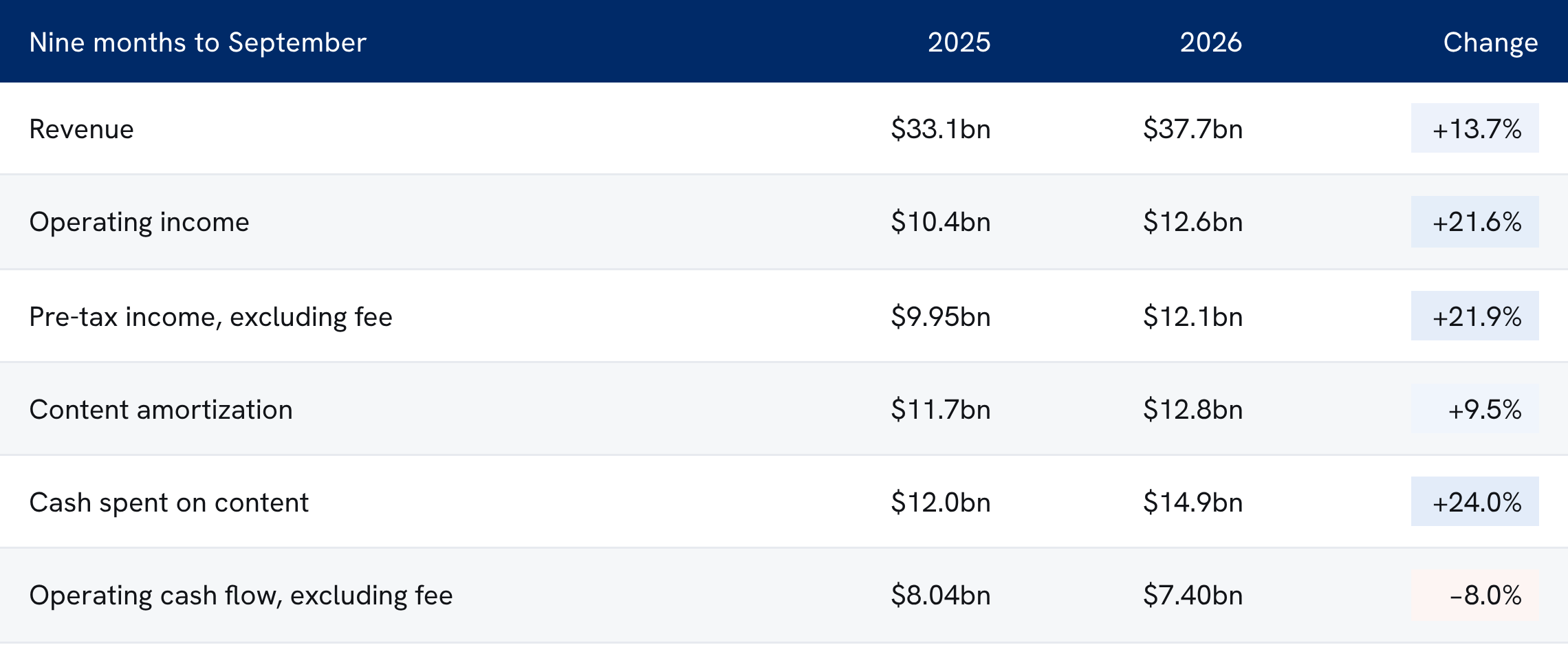
Netflix, Inc., nine months to 30 September 2025 and 2026: revenue, operating income, income before income taxes, content amortization, additions to content assets and net cash provided by operating activities.
Source: Netflix, Inc., Form 10-Q for the quarter ended 30 September 2026, filed with the SEC on 21 October 2026. Seven Measures calculations.
The $2.8bn termination fee is removed from 2026 pre-tax income and operating cash flow at the amount the filing reports, rounded to the nearest $100m, and before any tax on it. Operating cash flow in 2026 also absorbed $729m of non-routine payments for the Brazilian tax assessments.
Excluding the fee, pre-tax income rose 21.9 per cent, close to the 21.6 per cent rise in operating income. Operating cash flow did not follow. It was $10.20bn as reported, and $7.40bn without the fee, 8.0 per cent less than a year earlier. Adding back the $729m Brazilian payment as well leaves it 1.1 per cent higher. On either measure, the cash the business generated grew much more slowly than its earnings.
Cash for Content Is Running Ahead of the Charge
The reason is the largest line in the cost base. Netflix capitalises what it pays to license and produce content and amortizes it, on an accelerated basis, from the month a title becomes available. The annual report states that, on average, over 90 per cent of a title is amortized within four years of its release.
Content Cash Spending and Amortization, Quarterly
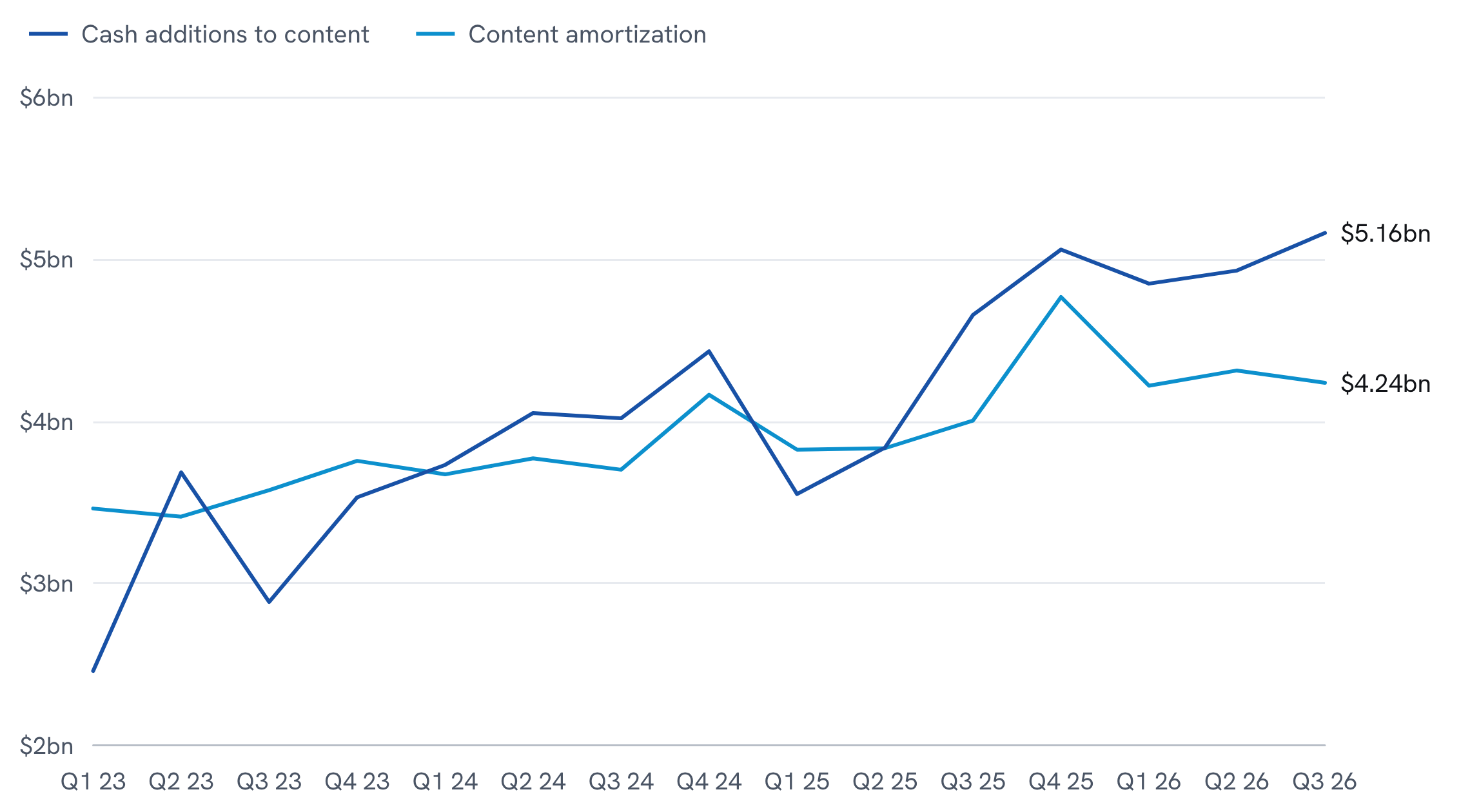
Netflix, Inc., additions to content assets and amortization of content assets, $ per quarter, first quarter of 2023 to third quarter of 2026.
Source: Netflix, Inc., Forms 10-Q and 10-K for the periods from June 2023 to September 2026, consolidated statements of cash flows, retrieved from SEC EDGAR on 23 October 2026. Seven Measures calculations.
First and fourth quarters are derived from six-month and annual totals. Every derived quarter matches the prior-year column of the following year's filing exactly.
In the third quarter Netflix paid $5.16bn for content and charged $4.24bn. Cash spending was 1.22 times amortization, the highest ratio in the fifteen quarters shown; in the same quarter of 2025 it was 1.16. Over the twelve months to September, cash spending ran $2.46bn ahead of amortization, against $0.65bn over the previous twelve months. In 2023, when the writers' and actors' strikes halted productions, the relationship ran the other way.
The balance sheet shows where the money has gone. Produced content still in production was $10.91bn at the end of September, 18.4 per cent more than at the end of 2025, and content assets in total rose to $34.61bn. Their costs are capitalised as they are incurred, and amortization does not begin until they are released. Content obligations, which include commitments not yet on the balance sheet, rose from $24.0bn to $25.2bn over the same nine months.
From Earnings to Cash
The cash flow statement reconciles the two. Content is the only adjustment of any size.
Nine Months to September 2026, Net Income to Cash
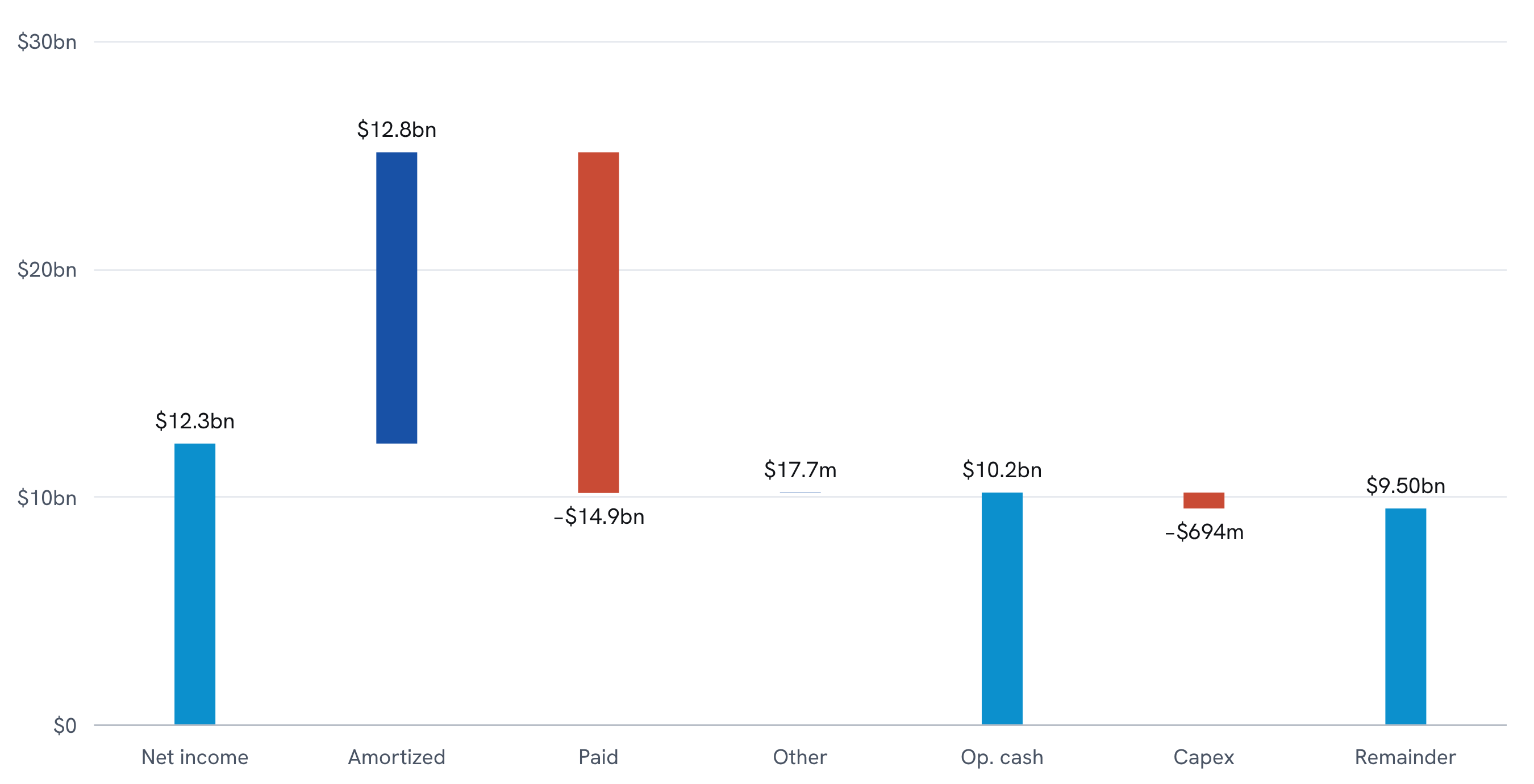
Netflix, Inc., nine months to 30 September 2026: net income, plus amortization of content assets, less additions to content assets, plus all other reconciling items, to net cash provided by operating activities; less purchases of property and equipment.
Source: Netflix, Inc., Form 10-Q for the quarter ended 30 September 2026, filed with the SEC on 21 October 2026. Seven Measures calculations.
Other items combine the change in content liabilities, a $43m outflow, with every remaining non-cash item and working-capital change, a $61m net inflow. The steps sum exactly to reported operating cash flow. Net income and operating cash flow both include the $2.8bn termination fee.
Net income exceeded operating cash flow by $2.15bn. Content paid for and not yet amortized accounts for $2.17bn of that; every other reconciling item, from depreciation and stock-based compensation to the Brazilian payment and deferred taxes, nets to an $18m inflow.
Investment Implications
The firm reads one thing from this. Netflix's margin this year has been carried partly by amortization growing more slowly than revenue, 9.5 per cent against 13.7 per cent over nine months, while the cash behind future amortization has grown by 24.0 per cent. Because over 90 per cent of a title's cost is charged within four years of release, spending that runs ahead of amortization now is charged to earnings as those titles reach the service.
Our base case assumes cash spending stays near its current rate and amortization accelerates towards it as the $10.91bn of content in production is released, so that content amortization grows faster than it has this year and absorbs part of the revenue growth that has lifted the margin. Revenue growing faster than the 13.7 per cent of the first nine months, or a slowdown in content spending, would raise the likelihood of a different path in which the margin keeps widening.
What resolves it is dated. The annual report for 2026 will give fourth-quarter additions and amortization, and the quarterly reports through 2027 will show whether amortization growth rises towards cash spending growth. The work this note has not done is to estimate the amortization schedule of the content in production, which the filings do not give title by title.