Oracle filed its first-quarter Form 10-Q on 11 September. It discloses $664 billion of remaining performance obligations at 31 August 2026 — revenue the company is contracted to deliver and has not yet delivered. Against a fiscal 2026 revenue of $67.4 billion, that is close to ten years of sales already sold.
A backlog is a promise, and promises of this size are usually read as the answer to the question. The note the firm published in August on power equipment argued that an order book is only half the equation, and that the other half is what the seller can actually build. Oracle reports both halves in the same filing. This note reads the second one.
What the Quarter Reports
Revenue Rose by a Third and Capital Spending More Than Tripled
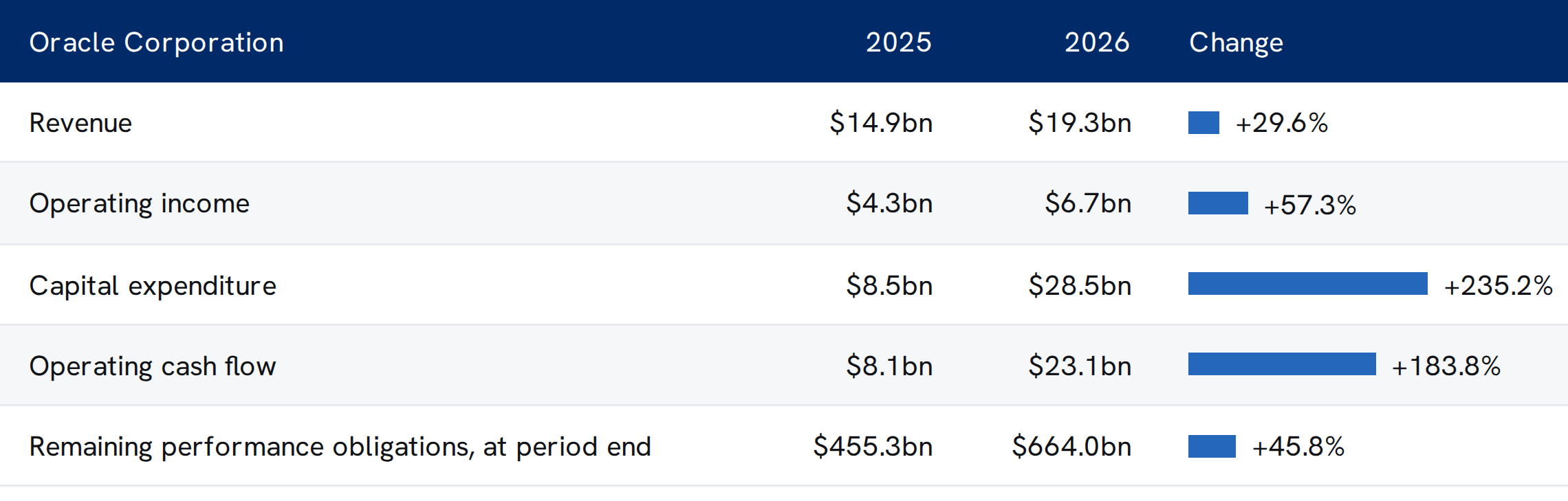
Oracle Corporation results for the three months to 31 August 2025 and 31 August 2026, with remaining performance obligations at each of those dates. US dollars
Source: Oracle Corporation Form 10-Q for the quarter ended 31 August 2026, filed 11 September 2026, and the comparative figures reported within it. Retrieved from SEC EDGAR on 21 September 2026.
Revenue grew 29.6 per cent and operating income 57.3 per cent. Neither is the number that changed the shape of the business. Capital expenditure was $28,499 million in the quarter, against $8,502 million a year earlier. That is 147 per cent of the revenue the company booked in the same three months, and it does not include a further $6,247 million of capital expenditure the filing records as incurred but unpaid.
The Spending Passed the Cash Flow Six Quarters Ago
A company can outspend its own cash generation for a while without much being said about it. Oracle has now done so for six consecutive quarters, and the gap is widening rather than closing.
Capital Spending Has Exceeded Operating Cash Flow in Every Quarter Since May 2025
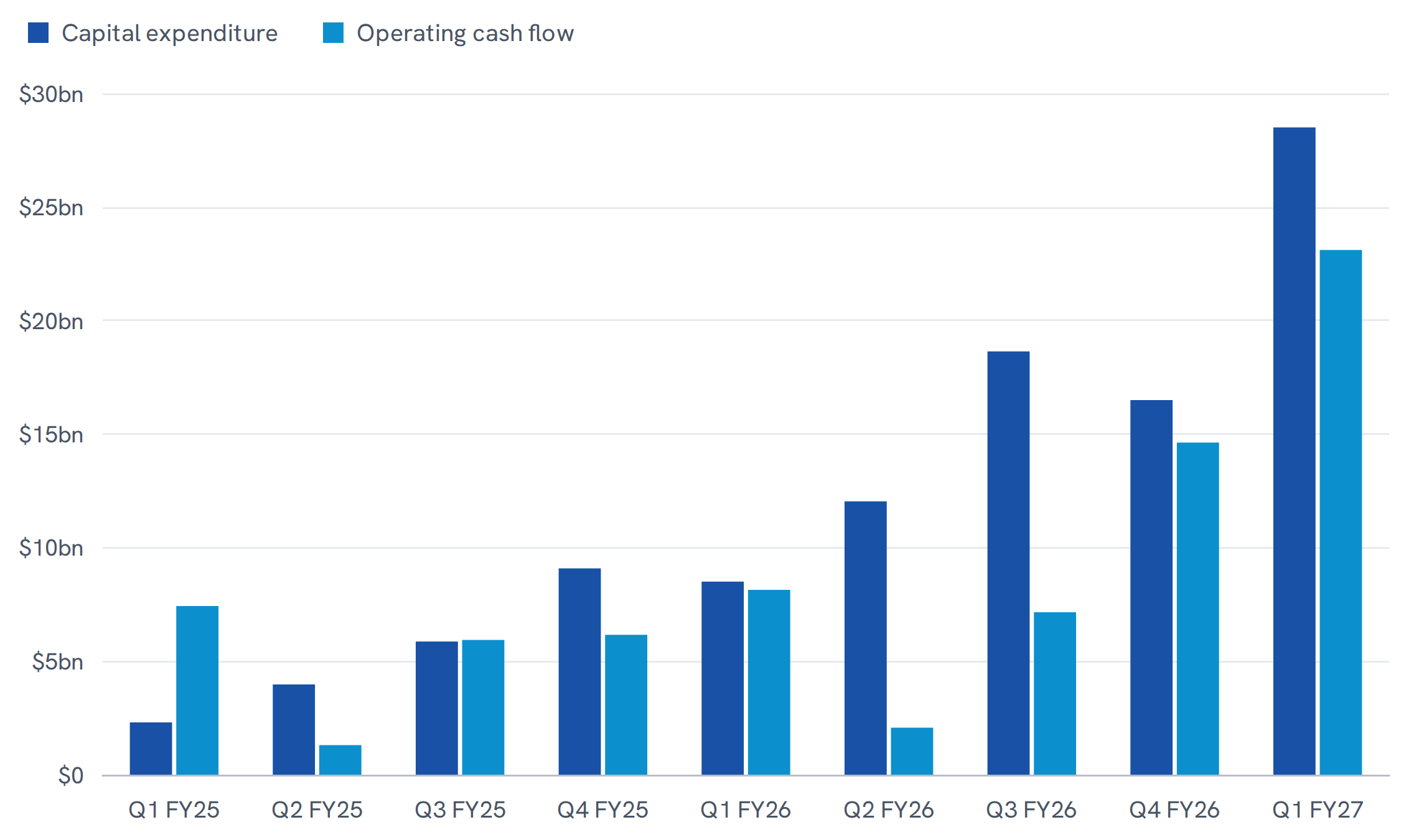
Oracle Corporation quarterly capital expenditure and net cash provided by operating activities, US dollars, fiscal first quarter 2025 to fiscal first quarter 2027. Oracle's fiscal year ends 31 May
Source: Seven Measures calculations on Oracle Corporation Forms 10-Q and 10-K. Quarterly figures are the differences between the cumulative year-to-date amounts each filing reports. Retrieved from SEC EDGAR on 21 September 2026.
The fourth fiscal quarter is derived by subtracting the nine-month figure from the annual figure in the Form 10-K.
The last quarter in which operations produced more cash than the company spent on property and equipment ended in February 2025, and it did so by $71 million. Over the six quarters since, capital expenditure has exceeded operating cash flow by $32.0 billion in total.
Where the Money Came From
The cash flow statement answers this directly, and two of its lines are new.
Half the Operating Cash Flow Was Customer Prepayment and the Gap Was Met by Issuing Shares
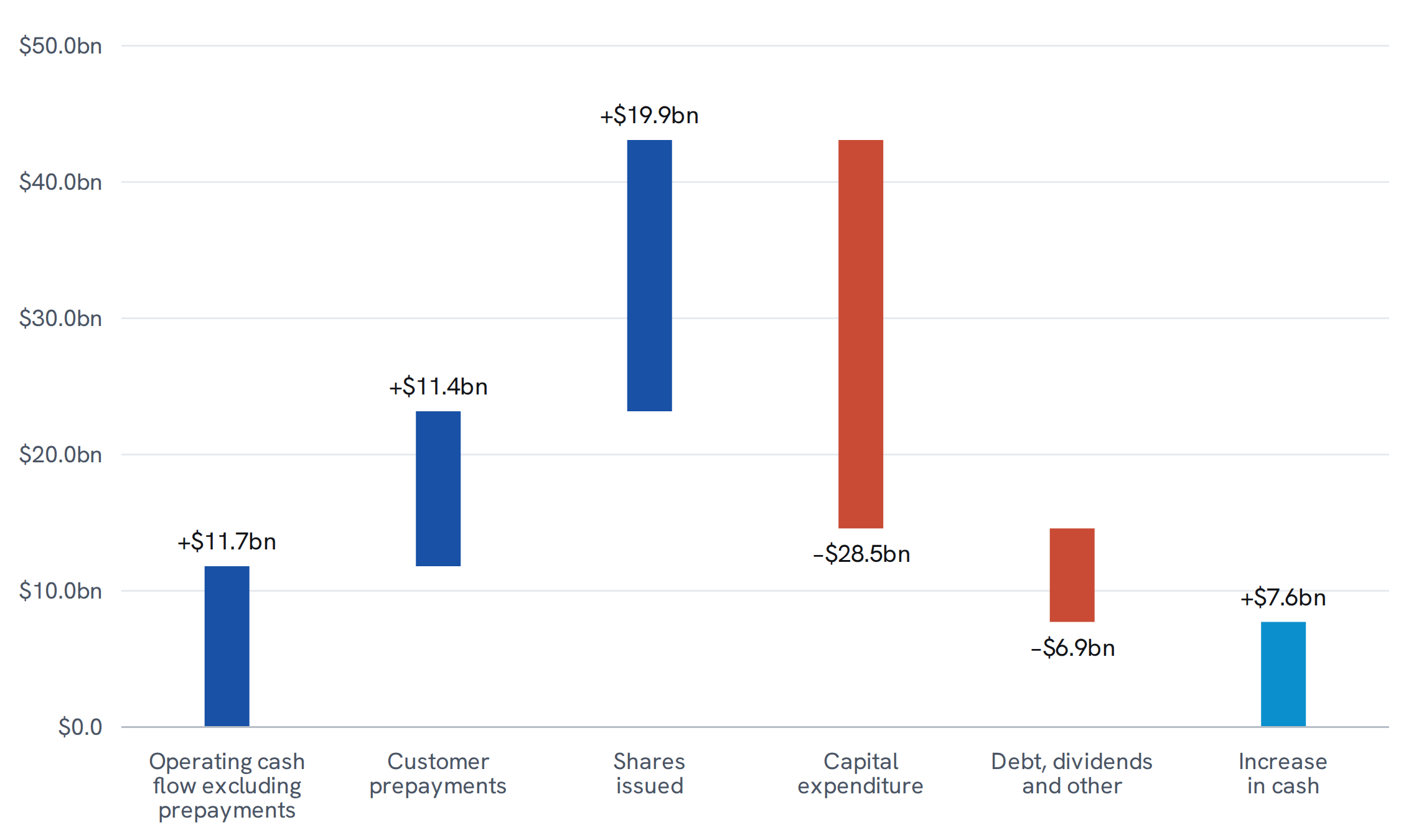
Sources and uses of cash at Oracle Corporation in the three months to 31 August 2026, US dollars
Source: Oracle Corporation Form 10-Q for the quarter ended 31 August 2026, condensed consolidated statements of cash flows. Retrieved from SEC EDGAR on 21 September 2026.
Debt, dividends and other combines $5,032m of debt and short-term financing repayments, $1,565m of dividends and $271m of net other items. The steps sum to the $7,645m increase in cash, cash equivalents and restricted cash the filing reports.
Of the $23,103 million of operating cash flow, $11,363 million is a single line: increase in deferred revenues from customer prepayments with a significant financing component. The same line was nil in the year-ago quarter. Excluding it, operations produced $11,740 million, against $28,499 million of capital expenditure.
The remainder came from $19,909 million of shares issued through an at-the-market programme, a line that was also nil a year earlier. Cash, cash equivalents and restricted cash ended the quarter at $38,934 million against $10,445 million a year before. The buildout in this quarter was funded by customers paying early and by shareholders paying in, not by the operating business.
How Quickly the Backlog Converts
The size of the obligation is disclosed. So is its timing, which is the part that determines whether the spending and the revenue ever meet.
Thirteen Per Cent of the Backlog Is Revenue Within Twelve Months
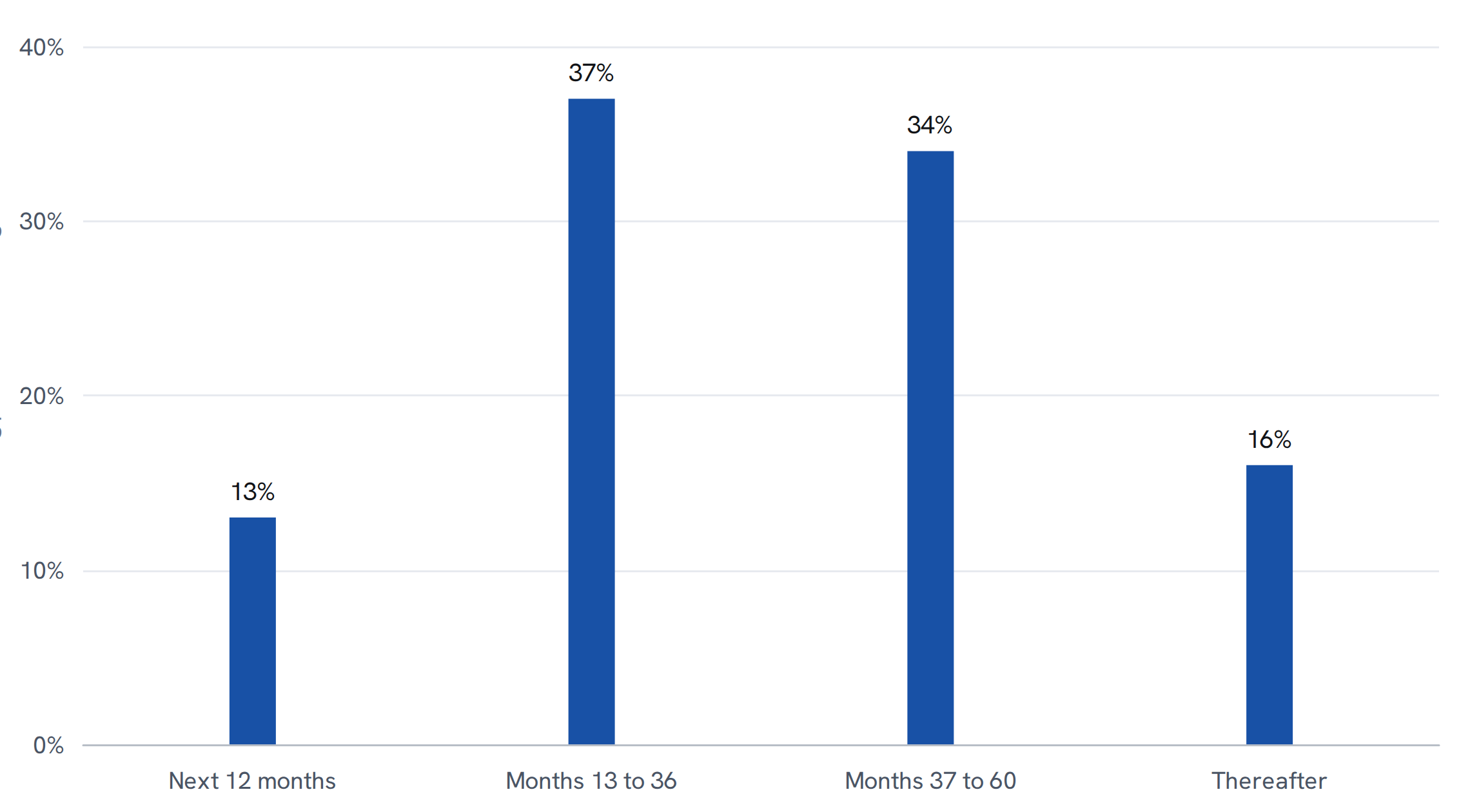
Expected recognition of Oracle's $664 billion of remaining performance obligations at 31 August 2026, per cent of the total
Source: Oracle Corporation Form 10-Q for the quarter ended 31 August 2026, Note 1. Retrieved from SEC EDGAR on 21 September 2026.
The filing states approximately 13 per cent over the next twelve months, 37 per cent over months 13 to 36 and 34 per cent over months 37 to 60, with the remainder thereafter. The final column is that remainder.
Thirteen per cent of $664 billion is about $86 billion of revenue over the next four quarters, against $67.4 billion in the fiscal year just reported. The capacity to deliver it is being bought now, in a quarter that cost $28.5 billion, and the revenue arrives across the following five years. Depreciation in the quarter was $3,156 million against $1,351 million a year earlier; that is the earlier spending beginning to reach the income statement, and the larger spending has not reached it yet.
Scenarios and What Would Resolve Them
The firm's base case is that the funding pattern in this quarter is a bridge rather than a steady state, because the two lines that closed the gap are not repeatable at this scale. Customer prepayment brings cash forward from revenue already contracted; it can be collected once per contract. Equity issuance is available repeatedly but is not costless, and $19.9 billion in a quarter is a size that is noticed. On that reading, operating cash flow excluding prepayments has to rise toward the capital expenditure line, or the capital expenditure line has to stop rising.
What would make that base case wrong in the direction of comfort is depreciation and revenue catching the spending. If the 13 per cent of backlog due within twelve months converts at the margins the company already earns, operating cash flow before prepayments grows into the gap without further issuance. The evidence for this is the operating income line, up 57.3 per cent on revenue up 29.6 per cent, which says the delivered business is currently getting more profitable rather than less.
What would make it wrong in the other direction is the spending continuing to compound against a backlog that converts over five years. Quarterly capital expenditure has gone from $8.5 billion to $28.5 billion in a year. Annualised at the latest quarter, which is the firm's arithmetic and not a company figure, that is $114 billion of capital expenditure against the $86 billion of backlog the filing schedules for recognition over the same twelve months. A configuration in which the building runs ahead of the delivering has to be funded from outside the operating business for as long as it lasts.
The figures that would settle it are all scheduled to be published. The next 10-Q reports the December quarter; the lines to read are capital expenditure, the customer prepayment line inside operating cash flow, any further use of the at-the-market programme, and whether remaining performance obligations continue to grow faster than the revenue being recognised out of them. The firm holds no view here on the price of the security, and this note offers none.