On Wednesday 16 September the Federal Open Market Committee raised the target range for the federal funds rate by a quarter point, to 3¾ to 4 percent, by a vote of twelve to nothing. The August note on the federal interest bill recorded three members preferring exactly that increase in July. They now have the whole Committee.
The question the market spent the summer arguing about has therefore been settled, and it turns out to have been the smaller one. The Committee has moved the overnight rate by twenty-four basis points since the start of the year. Over the same period the two-year Treasury moved a hundred and twenty. Whatever repriced in 2026, it was not the policy rate, and the difference decides where the cost is actually being paid.
The Curve Moved Without the Committee
The effective federal funds rate is published daily, as is every Treasury constant maturity yield, which makes the comparison a matter of reading two series rather than inferring anything.
One Step at the Front, a Year of Steps Along the Curve
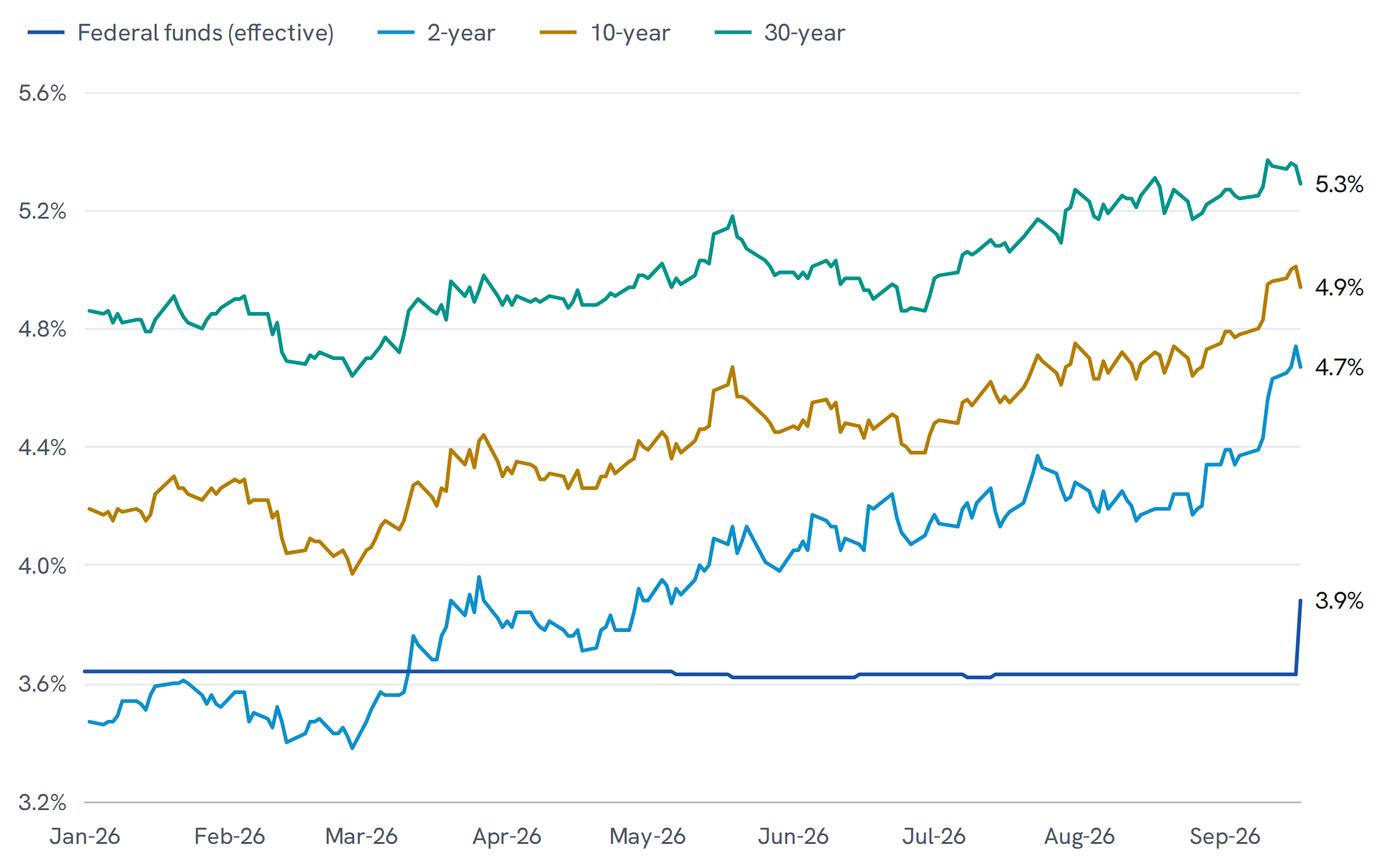
Effective federal funds rate and US Treasury constant maturity yields, per cent, daily from 2 January to 17 September 2026
Source: Board of Governors of the Federal Reserve System, H.15 Selected Interest Rates, retrieved from FRED, Federal Reserve Bank of St Louis, on 21 September 2026.
The single step in the funds rate is the increase announced on 16 September, which took effect the following day.
The funds line is flat for eight and a half months and then steps once. Every other line rises through the year, and the rise peaks at the two-year rather than at the front: the three-month, the maturity that follows the Committee most closely, moved less than half as far as the two-year. The two-year began the year seventeen basis points below the overnight rate and ended it seventy-nine above.
The Policy Rate Is the Smallest Move on the Page
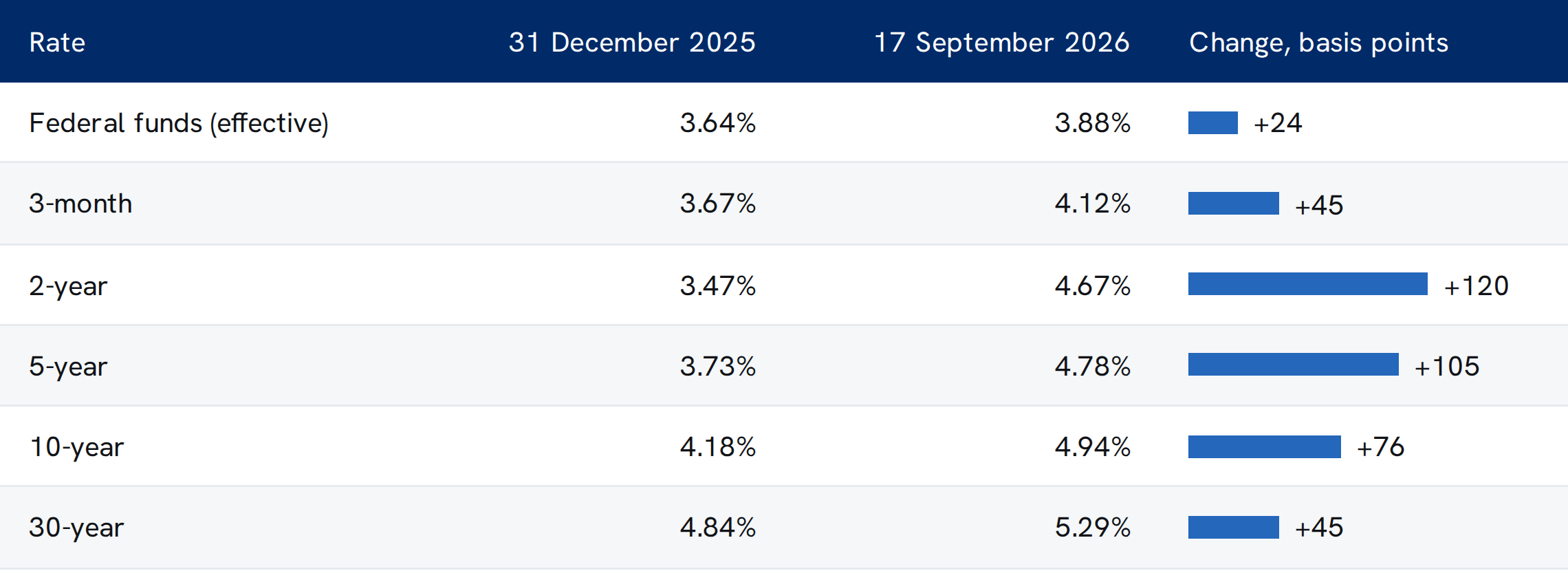
Effective federal funds rate and US Treasury constant maturity yields on 31 December 2025 and 17 September 2026, per cent, with the change in basis points
Source: Board of Governors of the Federal Reserve System, H.15 Selected Interest Rates, retrieved from FRED, Federal Reserve Bank of St Louis, on 21 September 2026.
The funds rate moved once, by twenty-five basis points; the twenty-four shown here is the change over the full period, which began one basis point higher than the rate that prevailed for most of the year.
The shape of that column matters as much as its size. The two-year moved a hundred and twenty basis points, the five-year a hundred and five, the ten-year seventy-six and the thirty-year forty-five. The curve did not shift; it pivoted. The spread between the two-year and the thirty-year has gone from a hundred and thirty-seven basis points at the end of last year to sixty-two, and the two-year to ten-year spread from seventy-one to twenty-seven.
A flattening of that kind is usually read as the market pricing more tightening now and less growth later. That reading is available here. It is also testable, because the Treasury issues a security that separates the two halves of a nominal yield.
Almost None of It Is Inflation
A nominal Treasury yield is the sum of the real yield on the inflation-protected security of the same maturity and the inflation compensation implied by the difference between them. The identity holds to the basis point on both of the dates used here, so the decomposition is arithmetic rather than a model.
Sixty-Eight of the Ten-Year's Seventy-Six Basis Points Are Real
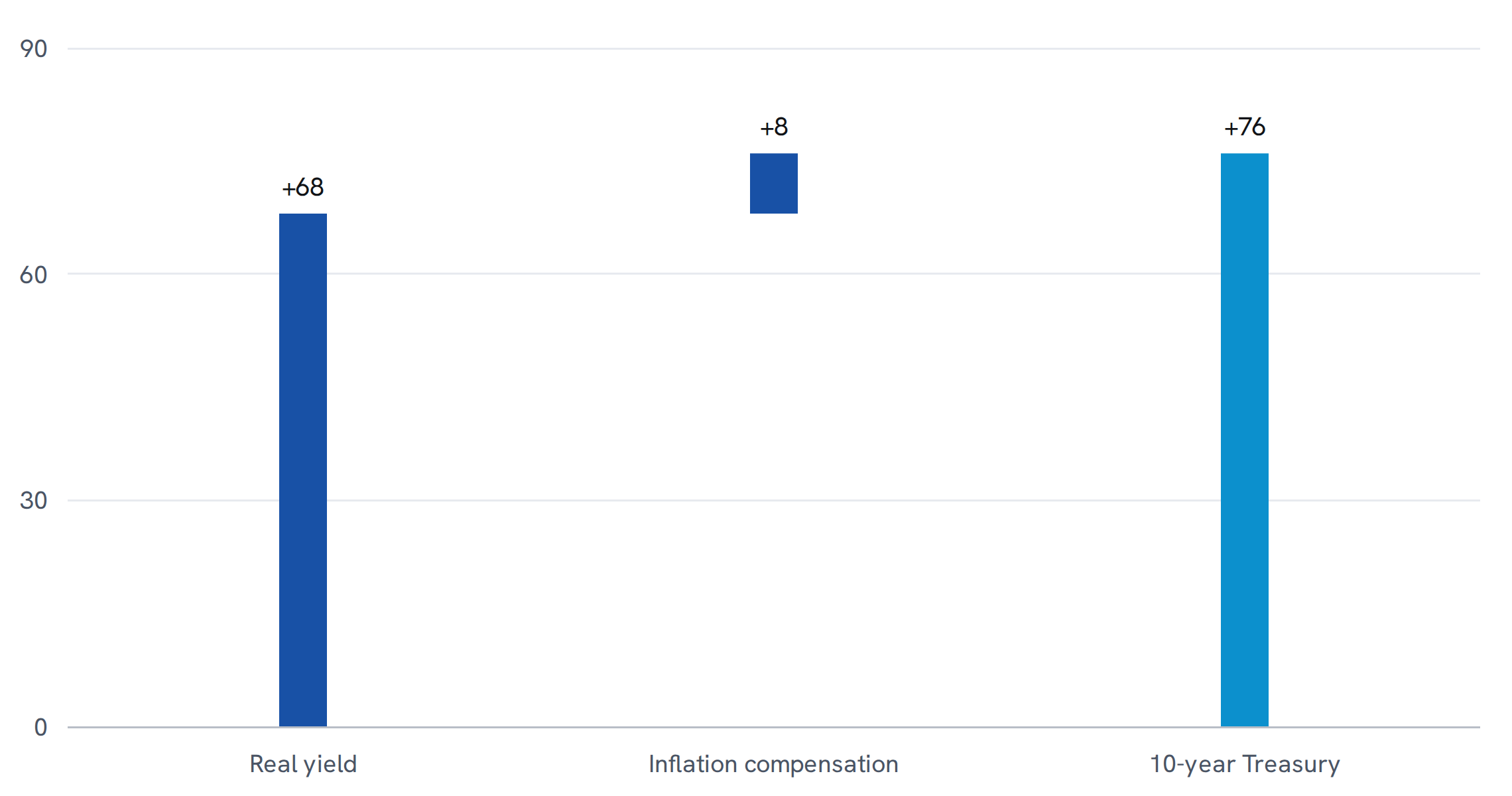
Contributions to the change in the ten-year US Treasury yield between 31 December 2025 and 17 September 2026, basis points
Source: Seven Measures calculations on the ten-year Treasury inflation-indexed constant maturity yield and the ten-year breakeven inflation rate, Board of Governors of the Federal Reserve System, retrieved from FRED, Federal Reserve Bank of St Louis, on 21 September 2026.
The two contributions sum to the nominal change by construction. Inflation compensation is the breakeven rate, not a survey or a forecast.
The ten-year real yield rose from 1.93 per cent to 2.61. Ten-year inflation compensation rose from 2.25 per cent to 2.33. Eighty-nine per cent of the move in the benchmark nominal yield is the real cost of money, and the five-year is starker still: of its hundred and five basis points, ninety-nine are real and six are inflation compensation.
One Line Climbed and the Other Did Not
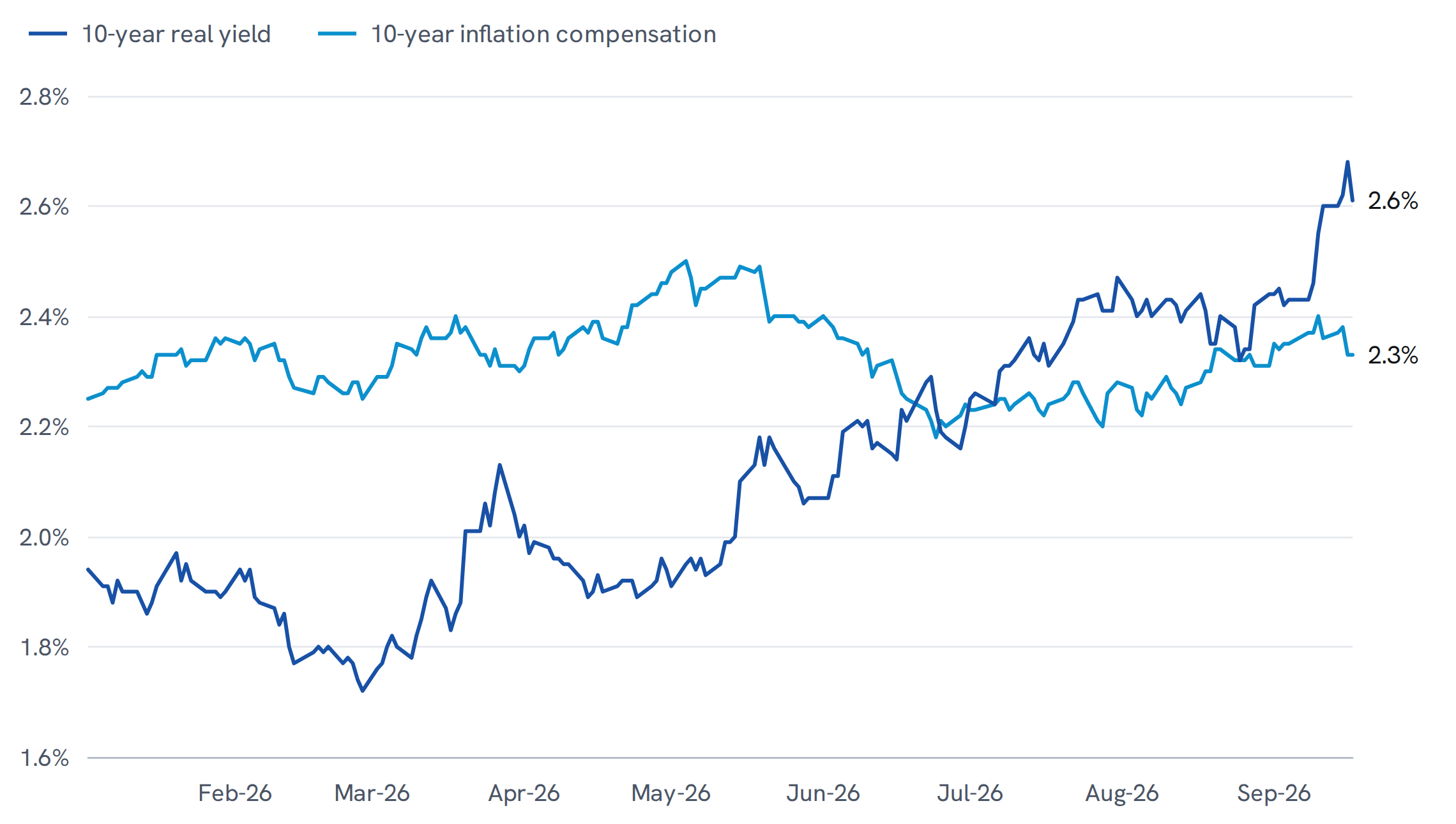
Ten-year US Treasury inflation-indexed constant maturity yield and ten-year breakeven inflation rate, per cent, daily from 2 January to 17 September 2026
Source: Board of Governors of the Federal Reserve System, retrieved from FRED, Federal Reserve Bank of St Louis, on 21 September 2026.
Both series are in per cent and sum to the nominal ten-year yield, so they are drawn on one scale.
The two lines start the year three-tenths of a point apart, cross for the first time on 22 June and hold the new order from 7 July. Inflation compensation has spent the year inside a range of 2.18 to 2.50 per cent, about a third of a point. The real yield has traversed 1.72 to 2.68, very nearly a full one.
The meeting itself is the clearest single instance. The Committee's statement said that inflation remains elevated and that the increase would support a timelier return to the two per cent goal. In the two sessions around it, ten-year inflation compensation fell five basis points, to 2.33 per cent, and the ten-year real yield rose six, to 2.68, before giving back seven basis points as the nominal yield fell on the day the new rate took effect. The market took the Committee at its word on inflation and repriced the real rate instead.
What Did Not Move
If a rising real rate were the market pricing a slowdown, the price of corporate credit would be the first place to show it. It has not shown it.
The Things That Repriced, and the One That Did Not
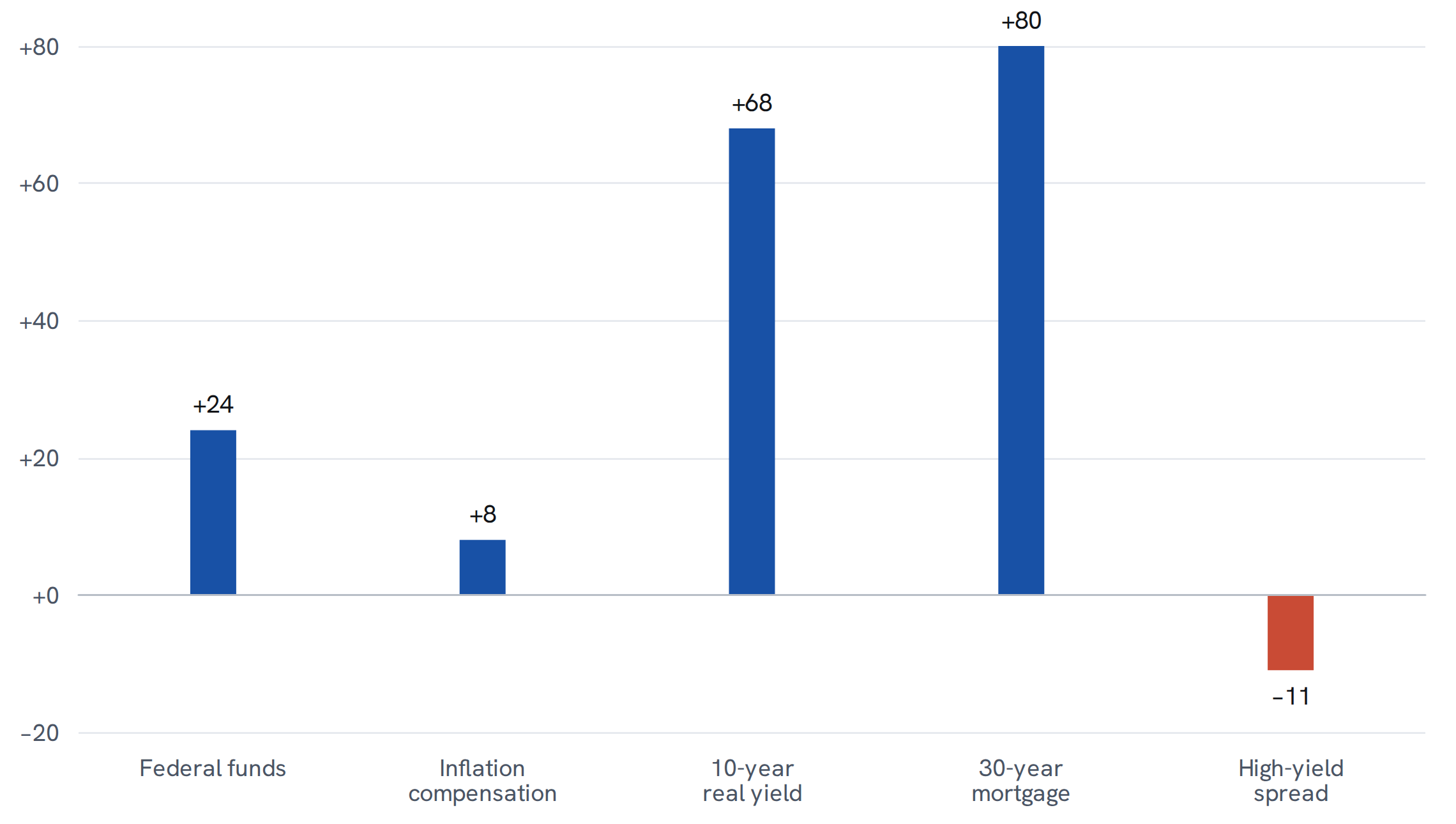
Change between 31 December 2025 and 17 September 2026, basis points
Source: Board of Governors of the Federal Reserve System; ICE BofA US High Yield Index option-adjusted spread; Freddie Mac 30-year fixed rate mortgage average. All series retrieved from FRED, Federal Reserve Bank of St Louis, on 21 September 2026.
The mortgage average is weekly and is compared on the nearest published weeks, 31 December 2025 and 17 September 2026.
The option-adjusted spread on US high yield went from 2.81 per cent to 2.70. It widened to 3.46 on 30 March and spent the rest of the year coming back in. A credit market pricing a real cost of money nearly a point higher, and a slowdown with it, does not end the period tighter than it began.
The thirty-year mortgage average went from 6.15 per cent to 6.95, a move of eighty basis points against the Committee's twenty-four. This is where a real rate reaches a household, and it has moved more than three times as far as the rate the Committee sets.
Investment Implications
The firm reads three things from this. First, that positioning on the Committee's next decision is positioning on the smallest variable on the page. The overnight rate accounted for twenty-four of the hundred and twenty basis points that repriced the two-year and none of the eighty that repriced a mortgage. A second increase, or none, changes the front of the curve and leaves the rest of this intact.
Second, that the discount rate applied to long-duration assets has risen by roughly seventy basis points in real terms this year while inflation compensation has not moved. The S&P 500 closed 17 September 11.6 per cent above its close for 2025, so those prices were marked up against a real ten-year rate that rose by more than a third over the same nine months. That is a revision to the denominator the index level does not show.
Third, that credit is not corroborating a growth scare. Spreads ending the period tighter than they started, through a spring that took them to 3.46 per cent and back, is not the behaviour of a market pricing the slowdown that a flattening curve is usually read to imply. Either credit is wrong about growth or the curve is not saying what it is being read to say, and the firm's working assumption is the second.
What would change this reading is inflation compensation moving. A breakeven that rises with the nominal yield would make this an inflation story after all, and would change which assets are hurt by it. That has not happened in nine months. The work that would sharpen this note, and which it has not done, is the split of the real yield into expected short rates and term premium, because the two imply different things about what a long bond is worth.